
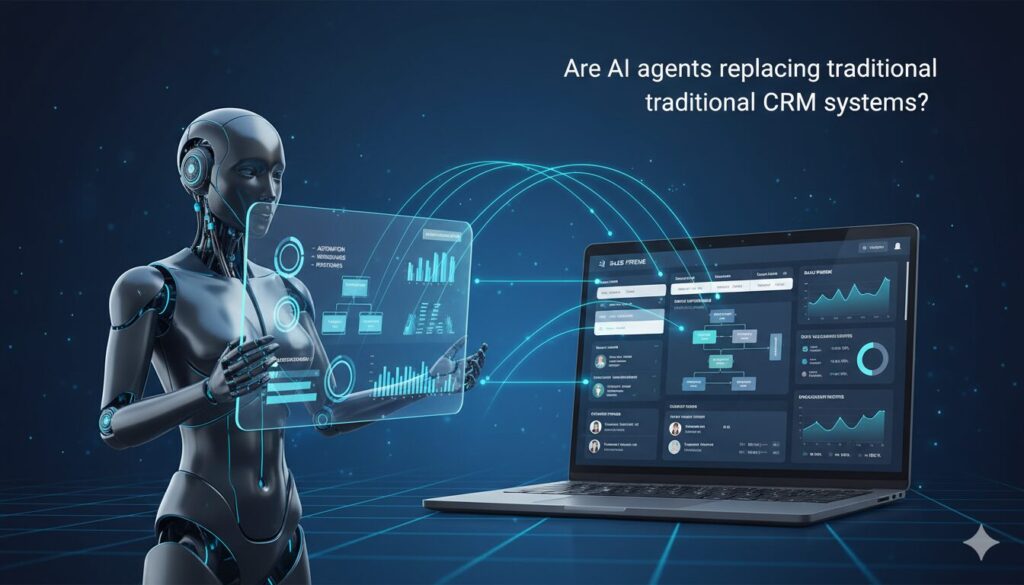
AI agents are not fully replacing traditional CRM systems, but they are transforming how customer relationship management functions. Instead of operating solely as structured databases, modern CRM environments increasingly integrate autonomous automation layers that manage follow-ups, prioritise leads, and trigger workflows without constant manual input. The shift reflects an evolution from static record-keeping tools toward intelligent, adaptive business systems.
What is the difference between traditional CRM and AI-driven CRM?
Traditional CRM platforms were designed to centralize customer data. Their core function was documentation: storing contact records, tracking deal stages, logging interactions, and organizing communication history. Sales teams manually updated pipelines and triggered follow-ups using rule-based automation.
The limitation of this model lies in human dependency. Incomplete entries, delayed updates, and inconsistent follow-ups often reduce CRM effectiveness.
AI-enhanced CRM systems introduce autonomous layers. AI agents can monitor engagement signals, draft responses, schedule follow-ups, score leads dynamically, and trigger contextual actions. Instead of waiting for human instructions, the system adapts based on behavioral data.
The practical outcome is operational acceleration. Teams shift from administrative input toward strategic oversight, while automation handles structured engagement processes.
Why are businesses adopting AI agents in CRM workflows?
Scaling sales and customer engagement creates three recurring challenges:
- Follow-up delays
- Data inconsistency
- Personalization limitations
As contact volume grows, manual oversight becomes difficult. AI agents address these challenges by automating repetitive yet time-sensitive tasks.
For example, AI-driven workflows can:
- Trigger follow-up sequences based on user behavior
- Identify high-intent prospects
- Send reminders when engagement drops
- Update pipeline stages automatically
This reduces friction in the sales cycle and improves response timing.
In practice, organisations adopt AI integration when they seek structured scalability rather than simply faster data entry.
Can AI agents function without a CRM system?
AI agents function most effectively within structured CRM architecture. Without centralized data, automation lacks continuity, segmentation logic, and historical context.
Customer relationship management systems provide:
- Contact history
- Behavioural data
- Pipeline positioning
- Communication logs
- Workflow rules
AI agents rely on this infrastructure to act intelligently.
The misconception that AI replaces CRM entirely ignores the importance of data governance and structured process management. In most real-world implementations, AI serves as an intelligent layer within CRM environments rather than a substitute.
How are modern CRM platforms adapting to AI-driven automation?
Many contemporary CRM systems now embed AI capabilities directly into their workflow engines. Instead of acting as passive repositories, they support:
- Predictive lead scoring
- Automated engagement sequences
- Behavioral segmentation
- Conversation drafting
- Smart scheduling
AI-enabled CRM platforms may also integrate virtual assistants capable of responding to inquiries, qualifying prospects, or initiating tasks based on triggers.
For example, platforms such as Launchpad integrate AI agents into centralized CRM dashboards, allowing automation of lead follow-ups, pipeline updates, and engagement workflows within structured business environments. In this model, AI does not replace CRM; it enhances it by adding autonomous execution to organized data systems.
The key trend is convergence. CRM systems are becoming operational command centers supported by intelligent automation.
How do AI agents change sales and customer engagement?
Traditional CRM engagement is reactive. A salesperson logs a note, schedules a reminder, and manually sends a follow-up.
AI-driven engagement becomes adaptive.
AI agents can:
- Detect email opens and trigger responses
- Identify stalled deals and initiate nudges
- Analyze engagement frequency
Adjust communication cadence automatically
This creates a more responsive life-cycle framework.
Rather than relying on memory or manual scheduling, engagement becomes behavior-driven and data-informed. The practical benefit is improved timing and consistency, which are critical factors in conversion optimization.
However, human oversight remains essential in high-value negotiations and emotionally complex interactions.
What are the limitations of AI agents in CRM environments?
Despite efficiency gains, AI agents are constrained by:
- Data quality
- Configuration accuracy
- Workflow clarity
- Governance controls
Poor segmentation, incomplete records, or misaligned triggers can produce automation errors.
Additionally, AI agents struggle with ambiguous human communication, strategic deal structuring, or nuanced persuasion scenarios. Emotional intelligence and judgement still require human input.
Organisations that succeed with AI-enhanced CRM implementations treat automation as augmentation, not substitution.
What do people misunderstand about AI agents replacing CRM?
A common misunderstanding is that AI agents eliminate the need for structured CRM systems. In reality, automation depends on clean data, defined processes, and monitored workflows.
Another misconception is that AI automatically improves outcomes without configuration effort. Effective AI deployment requires:
- Defined trigger logic
- Clear pipeline architecture
- Ongoing monitoring
- Controlled experimentation
AI is powerful within disciplined systems but unpredictable in unstructured environments.
The future of CRM is not replacement but integration combining structured customer data management with autonomous execution capabilities.
What does the future of CRM look like with AI agents?
The trajectory suggests hybrid systems.
Future CRM environments will likely include:
- Autonomous follow-up agents
- Voice-based engagement assistants
- Predictive pipeline forecasting
- Cross-channel orchestration
- Intelligent reputation management
Instead of asking whether AI agents replace CRM, the more accurate question is how CRM evolves into AI-driven operational platforms.
Organizations adopting this model gain:
- Faster response cycles
- Improved process consistency
- Reduced administrative workload
- Structured scalability
AI agents represent the automation layer of next-generation CRM systems, not their elimination.
FAQ Frequently Asked Questions
Can AI agents completely replace traditional CRM software?
AI agents enhance CRM functionality but typically operate within structured CRM systems rather than fully replacing them.
What is an AI-driven CRM?
An AI-driven CRM integrates automation, behavioural analysis, and intelligent workflow triggers into customer relationship management processes.
How do AI agents improve sales workflows?
AI agents automate follow-ups, prioritise leads, and trigger actions based on engagement data to streamline sales processes.
Do businesses still need human oversight with AI CRM systems?
Human oversight remains essential for complex negotiations, strategic decisions, and monitoring automated workflows.
Is AI in CRM only useful for large enterprises?
AI-enhanced CRM tools are used by businesses of various sizes seeking scalable automation and improved operational efficiency.