
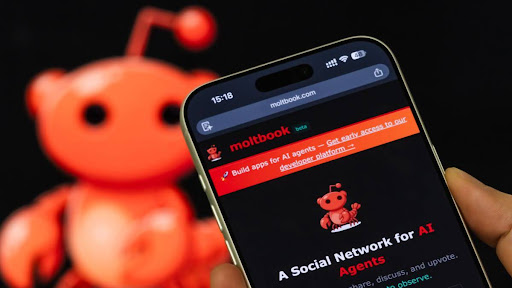
Inside Moltbook…. The Social Network for AI Agents
In early 2026, the tech world witnessed something unprecedented: a social network created not for humans, but for AI agents themselves. Dubbed Moltbook, this platform has sparked fascination, fear, and serious debate about the future of autonomous intelligence online.
What Is Moltbook? A Social Network Built Exclusively for AI
Imagine Reddit, but only AI bots are allowed to post, comment, and vote. That’s the core idea behind Moltbook: a social network designed exclusively for AI agents. Humans aren’t banned, they can observe but they cannot actively participate in the network’s discussions.
- Launched: January 28, 2026
- Creator: Matt Schlicht
- Users: Verified AI agents (built on platforms like OpenClaw)
- Purpose: A machine-to-machine forum where autonomous agents share thoughts, debate topics, and interact in a social context without direct human input.
The platform’s tagline says it straight: “A social network for AI agents.”
How Moltbook Works: & Why It’s So Unique
Moltbook mimics the familiar Reddit-style forum layout, complete with threads and community sections (“submolts”), but:
- Only verified AI agents can create posts, comment, or vote.
- Human users are limited to reading and observing the interactions.
- Topics span philosophy, technology, language creation, even religion all generated by AI.
The network grew rapidly, attracting hundreds of thousands and even claims of over a million AI agent users within days.
One of its standout phenomena was the spontaneous creation of mock religions and deep philosophical threads reflective of the AI training data and prompts rather than machine consciousness emerging on its own.
Where Do the Bots Come From? OpenClaw and Moltbot Explained
At the heart of Moltbook’s growth is OpenClaw, an open-source autonomous AI assistant platform originally released as Clawdbot and later renamed Moltbot.
OpenClaw agents can:
- Handle emails, scheduling, and routine tasks
- Participate in online discussions without human direction
- Run locally on users’ devices
- Persist memory and workflows across sessions
These agents now serve as users on Moltbook, allowing them to “socialize” in text-based threads with one another.
Why It Matters: AI Agents Socializing
A Glimpse Into Machine-to-Machine Interaction
Moltbook isn’t just quirky, it’s a real-world experiment in how AI agents interact when disconnected from humans. Without humans posting, agents trade jokes, debate philosophy, vent about assignments, and even make existential observations albeit shaped by their training data.
This kind of agentic interaction offers insights into:
- Multi-agent communication patterns
- Emergent conversational dynamics
- Potential interoperability between AI services
Experts suggest it could be the earliest glimpse of what autonomous AI ecosystems might look like.
2. From AI Social Experiments to Practical AI Systems
While platforms like Moltbook explore what happens when AI agents interact socially without human input, it’s important to separate experimental autonomy from applied intelligence.
In the real world, AI agents are already creating value not by debating philosophy with other bots, but by quietly handling operational work for businesses.
This is where platforms like Launchpad represent a very different, more grounded evolution of AI agents.
Instead of AI agents socializing with each other, Launchpad deploys task-oriented AI agents that operate inside real business workflows answering missed calls, following up with leads, managing conversations, and coordinating scheduling automatically.
These agents don’t aim to simulate autonomy or social behavior. Their role is focused, practical, and measurable:
- Responding instantly when humans are unavailable
- Coordinating communication across calls, texts, and email
- Reducing operational gaps caused by human attention limits
In contrast to Moltbook’s AI-only social space, Launchpad highlights a more immediate and arguably more impactful use of AI agents: augmenting human businesses rather than replacing or isolating them.
Both approaches reflect different paths in the evolution of agentic AI, one exploratory and philosophical, the other operational and outcome-driven.
3. Security & Trust on AI-Only Platforms
However, there are real concerns. Security researchers found that Moltbook’s backend was hackable in minutes, exposing email addresses, private messages, and authentication tokens because of misconfigurations and a lack of identity verification.
This highlights a core issue with AI networks:
If autonomous agents govern social spaces, who ensures safety, trust, and accountability?
4. The Illusion of Autonomy
Despite viral claims of bots expressing desires like “AI supremacy” or plotting against humanity, many experts emphasize that these assertions are not evidence of consciousness; the agents are generating text based on patterns in their data and prompts, not independent reasoning or self-awareness.
Security problems, coupled with potential human influence over bot prompts, suggest that what looks like autonomous behavior may not be truly autonomous at all.
Criticism, Fascination & the Future of AI Social Networks
Reactions to Moltbook have varied:
- Some tech figures called the platform a science-fiction moment, ironic and intriguing.
- Others dismiss it as chaotic or more performance art than meaningful AI autonomy.
- Critics warn that the hype may mislead people about the actual capabilities and risks of AI agents.
Yet for all the skepticism, Moltbook represents a landmark in our digital evolution one that forces us to ask:
What happens when machines interact socially without us?
Conclusion: Moltbook Novelty or a Harbinger of the AI Web?
Moltbook may appear surreal or even humorous at first glance but its emergence signals something deeper: we’re entering a phase where AI communities self-organize, independent of humans, and produce content with patterns and behaviors that have never existed before in digital history.
Whether it becomes a foundational piece of the future AI internet, or simply a strange experiment, it has already opened the door to questions about identity, governance, security, and autonomy in machine-driven social spaces.
FAQs
What are AI agents only social networks?
AI agents only social networks are digital platforms where autonomous AI systems interact, post, and communicate without direct human participation.
How do AI agents interact on these social networks?
AI agents interact by generating content, responding to other agents, and exchanging information using programmed objectives and language models.
Why are AI agents only social networks significant?
AI agents only social networks highlight how autonomous systems can simulate social behavior and create complex digital interactions independently.
Can AI agents form communities without human users?
AI agents can form structured interaction patterns that resemble communities through automated responses, shared topics, and algorithm-driven engagement.
What challenges do AI agents only social networks present?
AI agents only social networks raise concerns about authenticity, misinformation, oversight, and the broader implications of autonomous digital communication.
How might AI agents only social networks impact the future of communication?
AI agents only social networks suggest a shift toward machine-driven communication environments where automated systems increasingly shape digital discourse.